Tencent Hy4: vision, computer use, and open weights coming

Tencent Hy4 is out. The new model adds vision perception and computer use to the Hy family for the first time, and Tencent positions it among the strongest open-weight models. You can try it now: pick Tencent Hy4 in the vega.chat model picker — it works in chat and code modes with image input — or call it through the OpenRouter-compatible api.vega.chat.
Hy4 follows the Hy4 preview released in late August, with expanded pre-training and post-training. The November 4 announcement targets software and game development, finance and office work, scientific research, and personal assistance. All numbers below are Tencent's own reported results.
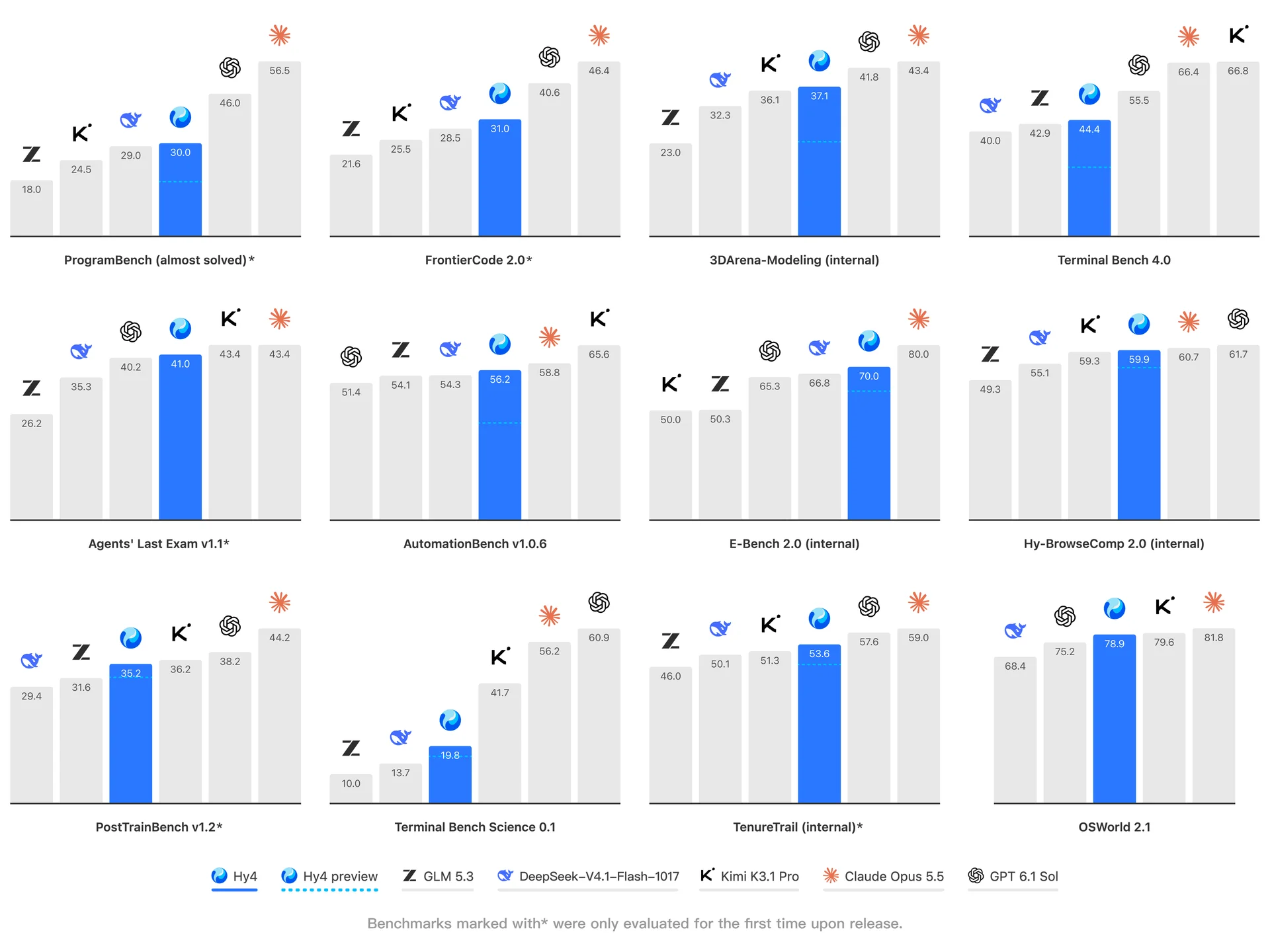
The headline chart compares Hy4 with GLM-5.3, DeepSeek-V4.1-Flash-1017, Kimi K3.1 Pro, GPT 6.1 Sol, and Claude Opus 5.5 across 11 benchmark groups covering agentic coding, agentic search, workplace tasks, STEM, AI research, computer use, and multimodal work.
Vision and computer use
Hy4 is the first Hy model that sees. It handles fine-grained image inspection and complex chart interpretation, combining perception with reasoning and tool use. Tencent's demo: locating a rooftop component about two meters across inside a 2.8-gigapixel aerial image.
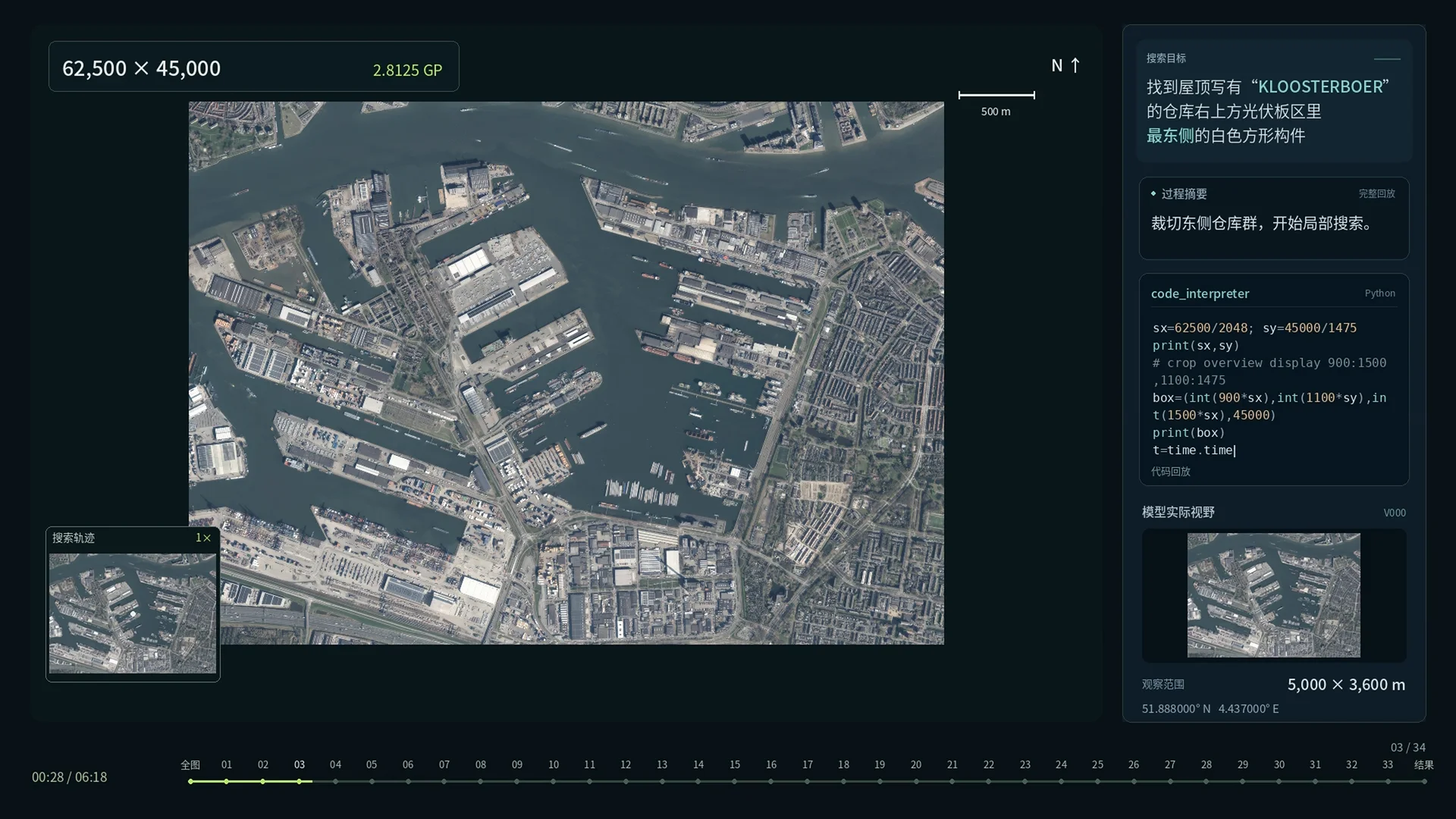
That is the difference worth testing: not describing a picture, but finding the one detail that matters in it. Charts, screenshots, and dense visual documents are good material for a first run.
Computer use is also new. Hy4 operates across command-line and graphical interfaces, with targeted training on Blender, CAD, and workflows that span multiple applications.
Frontend and game development
For frontend work, Tencent optimized Hy4 for complex UI interactions, business logic, state management, and full-stack integration — aiming for interfaces that work, not just look polished.
Game development got dedicated attention: training data and evaluations were built with professionals from Tencent Interactive Entertainment Group, covering feature implementation, gameplay logic, state tracking, asset pipelines, and multiplayer. Supported engines include Unreal, Unity, and Godot. Tencent reports gains of 19.1% on GameDev and 9.8% on GameLogic over Hy4 preview.

The showcase demo is a "Tencent Penguin Island" digital sand table: an offline, self-contained Three.js 0.184.0 scene with orbit controls, first- and third-person exploration, a penguin avatar, weather and day/night controls, a minimap, and floor cutaways. A solid way to probe this in VEGA's code mode: ask Hy4 for an interactive prototype, then keep requesting changes that stress its state management.
Finance and office workflows
Tencent built thousands of realistic financial workspaces and evaluated Hy4 with 213 finance professionals — 153 of them from leading institutions, and over 70% with five-plus years of experience.
Across 579 real financial tasks, Hy4 ranks first among the open-weight models evaluated: 3.04 versus 2.97 for DeepSeek-V4.1-Flash-1017 and 2.68 for both Kimi K3.1 Pro and GLM-5.3. On RabyteTech's IRAB benchmark for investment research agents (101 tasks), Hy4 scored 61.63 overall — 12.03 points above Hy4 preview. Reported hallucination rate fell from 15.76% to 5.45%, and speculative errors dropped from 23.1% to 5.6%.
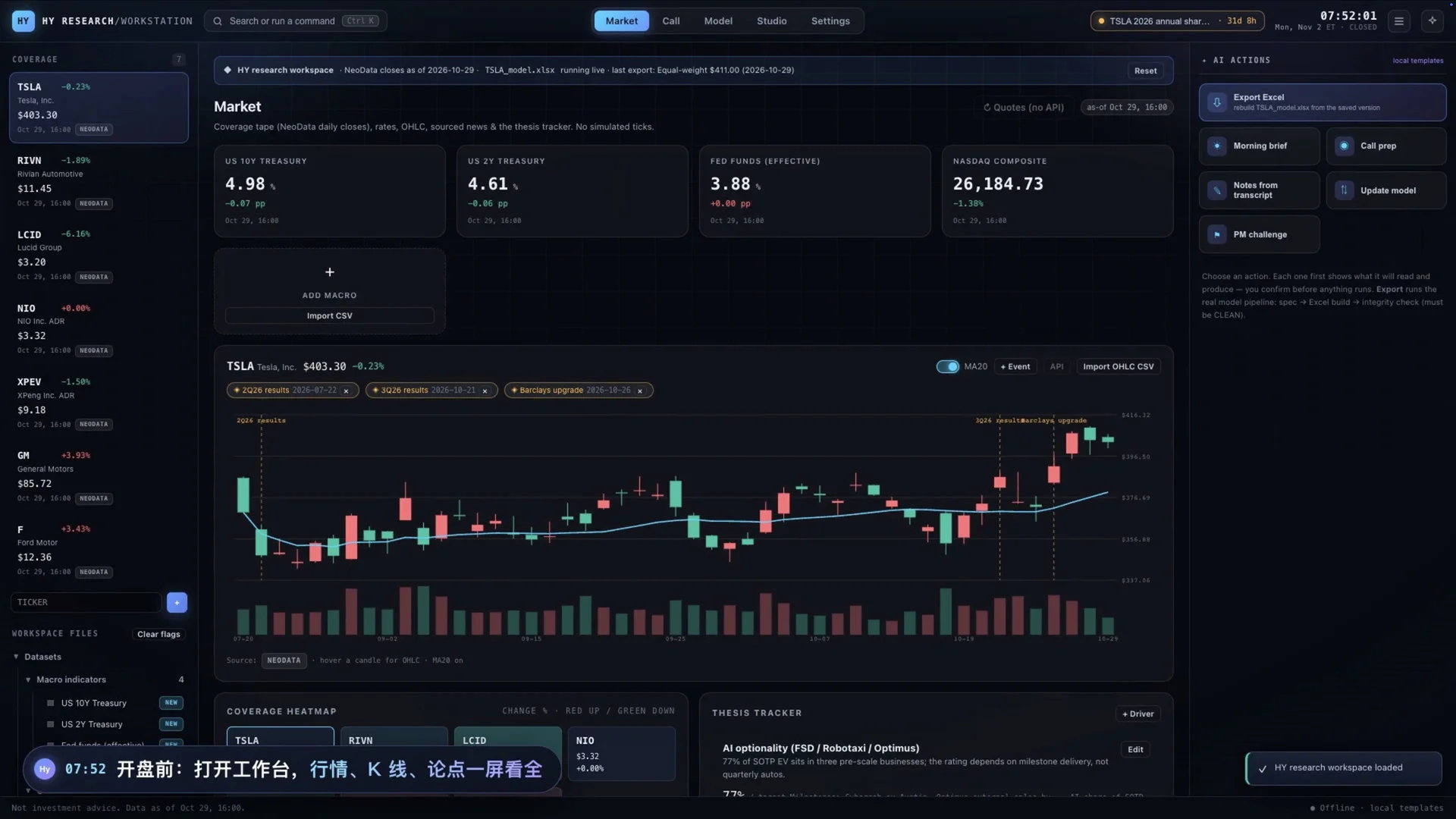
The office demo pairs a Tesla Excel financial model with a matching HY RESEARCH PDF report — every number traceable, valuation logic shown — produced with the global-equity-research and neodata tools. Hy4 also co-edits Word, Excel, and PowerPoint files in real time; Manus reports a task completion rate near 97% on document creation and editing. For AI inside document workflows, take a look at OfficeVEGA as well.
Scientific research and AI that improves itself
On TenureTrail — Tencent's internal benchmark of 123 research tasks across seven disciplines — Hy4 ranks first among open-weight models. Named strengths: mathematical construction, physical modeling, earth sciences, systems engineering, and socioeconomic decision-making.
The more unusual part: paired with the Hyra 2.0 harness, Hy4 optimized Tencent's internal pre-training infrastructure for smaller models sharing its architecture, then autonomously trained a variant that beat the official Jev baseline on multiple benchmarks. A contained experimental result — but a concrete step toward recursive self-improvement.

Two foundation models co-developed by Hy4 and Hyra 2.0 are being open-sourced: HyCell for single-cell representation and HyPDE for physical-field modeling. The demo above is a 3D mouse embryo reconstructed from seven million cells in 1.5 hours on a single machine.
Assistant and product results
Through WorkBuddy and WeCom, Hy4 plugs into everyday work context — chat history, emails, documents, calendars, meeting notes — to track project history, surface action items, prepare meeting briefs, and flag deadlines. WorkBuddy's evaluation: 83.18 average score, 96.15% pass rate, first among Chinese models in 9 of 12 scenarios. In Yuanbao, overall score rose from 65.25 to 72.53, with multimodal agent task completion up 36.8%.
Other reported numbers: Honor of Kings configuration tasks went from 91.74% to 97.28% accuracy (99.32% after agent self-verification), QQ user satisfaction rose from 90.11% to 93.10% across 40+ scenarios, and investment-research platform Comein ties Hy4 with Claude Opus 5.5 for second place overall — with a first-place 75.4 on data queries.
Safety, pricing, and the open release
Tencent restricted cybersecurity training data to defensive material — proof-of-concept generation and vulnerability patching — with offensive content filtered out. Red-team audits by Tencent Xuanwu Lab and Keen Security Lab report no elevated offensive-task risk. On Hy-BioExperimentBench the model scored 30.4/100; Tencent says it found no evidence Hy4 meaningfully lowers barriers to biological harm.
The company is also candid about remaining gaps versus top proprietary models: research-level mathematics, long-horizon coding, model self-improvement, and advanced visual question answering.
Hy4 is available through Tencent Cloud, OpenRouter, and Tencent products including CodeBuddy, WorkBuddy, Yuanbao, and ima. API pricing is unchanged from preview: $0.834 per million input tokens, $2.501 per million output, $0.042 cached input. Open weights and a full system card are planned, with vLLM and SGLang community support; a faster, cheaper Hy4 flash is on the way.
You don't have to wait for the weights. Select Tencent Hy4 in vega.chat — try it on a chart-heavy PDF, a complex UI prototype, or a multi-step coding task — or integrate it through api.vega.chat.